For Dermatology Residency Programs

Scheduling and compliance,
built by a dermatology PD.

Every week, dermatology program directors juggle Mohs blocks, continuity clinic, dermpath rotations, cosmetic exposure, ACGME duty hours, and GME reimbursement — across three sites, four PGY years, and a spreadsheet that breaks when anyone blinks. Orbit replaces the spreadsheet.

Request a Demo → See Why
Built by a practicing dermatology PD · ACGME-aware scheduling engine · GME-finance-ready
Assembly Board Grid Ops Deck
✨ Grade A · Ready to Launch
Mon 4/20
12/12
all filled
Tue 4/21
11/12
1 open
Wed 4/22
12/12
all filled
Thu 4/23
10/12
2 open
Fri 4/24
12/12
all filled
Main Campus 4 rooms
AM
CDr. ChenATT PPatelPGY-3 OOkaforPGY-1 MMartinezMA
PM
CDr. ChenATT AAlvarezPGY-2 RReyesMA
West Clinic 3 rooms · cosmetic day
AM
VDr. VegaATT LLeePGY-4 TTranMA
PM
VDr. VegaATT LLeePGY-4
Mohs Surgery Suite all-day block
Mohs block · Dr. Kim + Lee (PGY-4) + Nguyen (MA) · 8 AM – 4 PM
Academic / Non-clinic protected time
Dermpath rotation · Singh (PGY-2) · all day
HAL says

This week looks strong.

Patel is on track for 68h, below the 80h cap. Lee's Mohs exposure is at 14/20 target. Singh's dermpath week clears their Q2 goal.

Compliance
4-wk avg
64.8h
Max consec
5d
Days off
2.0
Continuity
3/4
Training gaps

Okafor (PGY-1) needs 3 more patch test exposures by June. Suggest West Clinic Thursday PM.

A Monday view of a derm residency week in Assembly Board mode.

Generic schedulers don't speak derm.

The scheduling problems a dermatology residency program faces don't look like the problems a hospitalist group or an ED faces. Orbit was built inside a working dermatology program — so the primitives match.

🔪

Mohs-aware blocks

Long procedural blocks, specific attendings, credential gating, and room pairing are all first-class — not a workaround.

📅

Continuity clinic tracking

Per-resident monthly attendance against target and minimum thresholds, with trend charts and auto-compliance flags.

🎯

Training exposure

Track each resident's exposure to dermpath, pediatric derm, cosmetics, phototherapy, patch testing — with target sessions and gap detection.

💰

GME finance ready

Medicare DGME/IME location data with CCN mapping, IRP weighting, and FTE calculation — one click instead of a semester of spreadsheets.

Compliant before you launch.

Most programs catch compliance problems after the fact — a violation email, a warning letter, a site visit surprise. Orbit's scheduling engine validates against ACGME rules during generation, and repairs violations automatically before the schedule is published.

80h

Weekly duty hour limit

80-hour rolling 4-week average, computed from real session times — not estimates. Flags violations and warnings before launch.

6

Consecutive day cap

Six-day maximum. Tracks across prior weeks so a Monday assignment can't quietly stretch a six-day streak to seven.

1/7

One day off per seven

Minimum one 24-hour period off per week, averaged over four weeks. Caught before the schedule goes out, not after.

Credential gating

Expired DEA, expired state license, missing board certification — Orbit blocks assignment at the cell level. Expiring credentials get warnings, not violations.

🔗

Cross-schedule conflicts

Multi-department programs: residents can't be double-booked across dermatology, medicine consult, and an elective the AI doesn't know about.

Week of Apr 20 ✨ Grade A · Ready to Launch
Avg 4-week hours 64.8 / 80
Max consecutive days 5 / 6
Days off per 7 2.0 avg
Credentials All current
Continuity target 3 of 4 residents

A live preview of what every program director sees before hitting Launch. Grades are computed from the actual schedule, not self-reported.

You build the week.
Your residents live it.

Chief residents and program coordinators get a builder. Residents, faculty, and MAs get a personal daily briefing. Same data, fundamentally different views — connected by a feedback loop that makes next week's schedule better than last week's.

Chiefs & Coordinators

Build

Assemble the week from a drag-and-drop board or grid. AI auto-generates respecting PGY level, credentials, preferences, Mohs blocks, continuity targets, and training exposure. Pre-launch mode lets you work in private until you're ready.

AI auto-generate with 10+ constraint types
Real-time fairness scoring by PGY and role
Mohs/continuity/dermpath rotation awareness
Pre-launch ACGME validation and auto-repair
Cross-rotation conflict detection

Residents & Faculty

Live

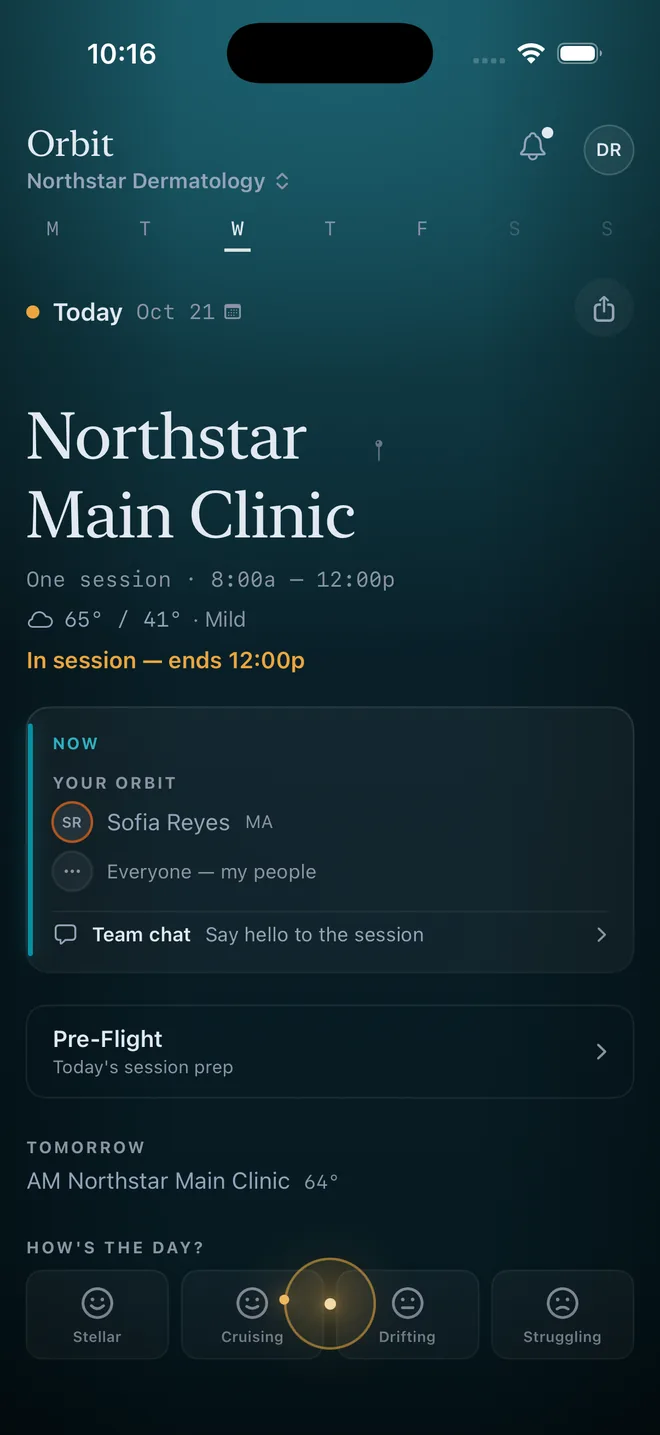
Each resident and attending opens their phone and sees a personal card — site, teammates, commute, session prep. Not a read-only copy of the grid. An enriched daily briefing with contextual AI.

Role-aware session prep (clinical refreshers for residents, setup tips for MAs)
"Ask HAL why" — AI explains your schedule
Duty hour attestation with one tap
Swap requests, PTO, coverage buddy built in
Training exposure tracking so you know what you're missing
The Feedback Loop

Residents rate sessions with one tap. Swap requests reveal patterns. Attestation data surfaces deviations from the schedule. Preferences become hard and soft constraints. All of it flows back into the AI, so next week's schedule avoids the slots that didn't work last week. The more your program uses Orbit, the better the schedule gets — with no extra work for the PD.

Everything a derm program needs.

One platform for scheduling, compliance, team communication, and program leadership. No separate tracking tool. No separate compliance spreadsheet. No separate GME finance export.

AI Auto-Generate

Build a full week in one click. Respects preferences, blocks, maxima, credentials, pairing rules, and training goals. Validates ACGME rules and repairs violations before returning.

Fairness by PGY

Track sessions per resident broken out by PGY year, AM/PM split, and site distribution. Spot imbalance in real time, not three weeks later.

🛡

Duty Hour Attestation

Residents attest actual hours worked daily with one tap. Moonlighting captured against the 80-hour cap. Deviation notes flow to the PD dashboard.

📚

Continuity Clinic

Per-resident monthly attendance with target and minimum thresholds. 6-month trend charts. Automatic compliance flags for residents falling behind.

🎯

Training Exposure Heatmap

Resident rows, procedure columns. See at a glance who needs more Mohs, who's behind on pediatric derm, who hasn't touched patch testing in a year. Export for ACGME site visits.

🚨

Mayday Coverage

Resident calls out. Mayday ranks available replacements by fairness, credentials, skill match, and pairing rules in seconds. One click reassigns the slot.

📱

My Orbit (Mobile)

Every resident's personal daily briefing. Site, teammates, session prep, duty hour card, props, check-in, team chat. Works on any phone, no app install required.

🧬

Program DNA

July handoff toolkit. Outgoing chiefs document pairing rules, scheduling patterns, and tribal knowledge — so incoming chiefs don't start from scratch every year.

🎓

Role-Aware Pre-Flight

Residents get clinical refreshers for site-specific procedures. MAs get room setup protocols. Rotators get site orientation. All AI-generated, from one "Pre-Flight" tap.

A collaborator, not a constraint solver.

HAL is Orbit's conversational AI. Chiefs ask it to build schedules, find replacements, explain fairness. Residents ask it where they can pick up a half day, what to prep for tomorrow, or why they got the schedule they got. It's not a form you fill out — it's a teammate you talk to.

📋

Schedule Builder & Validator

"Build next week" or "fill these gaps." ACGME rules, credentials, pairing, continuity, and training targets validated automatically. Repair loop catches violations before returning output.

🔍

Coverage & Availability

"Who's available Thursday PM?" "Find a replacement for Dr. Chen Monday." HAL scans the roster, credentials, PTO, pairing rules, and fairness in one query.

Fairness & Burnout

"Is my schedule fair?" HAL compares session count, AM/PM split, and site distribution against team average. Flags residents at risk of burnout across a 4-week rolling window.

🧠

Rule Capture

"Never pair Dr. Kim with PGY-1s on Mohs." HAL parses your sentence, validates it, flags conflicts, and writes it to config. Undoable in the same conversation.

🏛

Cross-Department Visibility

Multi-department programs: "Where are my residents today?" "Who's on loan to surgery this week?" HAL surfaces answers without leaving chat.

📅

Lookahead & Planning

"What does my month look like?" "When should I take PTO?" HAL returns lightest-load windows, new-teammate flags, and multi-week workload projections.

The view from the PD's desk.

Orbit is built by a PD, for PDs. The dashboards and exports are what you actually need for GMEC meetings, site visits, and reimbursement cycles — not generic analytics with a healthcare sticker.

📊

Program Dashboard

12-week aggregate view: ACGME grades, per-resident duty hours and violations, attestation rates, call distribution equity, conference attendance, training exposure gaps.

📄

Site Visit Report (ACGME)

One-click combined compliance + training + attestation PDF with grade banner, ACGME rule citations, cohort stats, and PD signature area. Built for site visit documentation.

💳

GME Finance Export

Medicare DGME/IME location data with CCN mapping, IRP weighting, FTE calculation, overlap detection, and data coverage summary. Upstream of MedHub/New Innovations cost report workflows.

🔓

Adoption Health

See which residents have claimed their account, which ones have push notifications on, who's set preferences, and who's actively using it. Nudge laggards with one click.

📢

Signals & Bulletins

Push role-targeted announcements, quizzes, and policy updates to residents. Read receipts, quiz scores, and engagement metrics tracked automatically.

📈

Ops Deck

Room fill rate, revenue gap from empty slots, per-site health cards, and chronic pattern detection across 12 weeks. For chairs who also run the clinical side.

PD
Founder, Orbit
Practicing Dermatologist
Department Chair
Residency Program Director

This isn't scheduling software a tech company built for doctors.

It's software a dermatology program director built for his own program — because the existing tools were either ancient (Amion), built for hospital-wide call schedules (Lightning Bolt, QGenda), or generic shift-scheduling SaaS with a medical sticker.

None of them understood Mohs blocks, continuity clinic targets, training exposure by procedure type, or the GME reimbursement headache. So Orbit was built inside a working program, by the person using it, every week.

“Every feature in Orbit exists because I got tired of doing it in a spreadsheet. If it's in here, it solves a real problem I've had running a dermatology residency.”
From spreadsheet to live schedule in a week.
01

We set up your program

Import your roster, sites, rooms, and Mohs/continuity blocks. We migrate from Amion or spreadsheets. Takes a few days, not a semester.

02

Generate your first week

AI auto-generate produces a validated ACGME-compliant draft. You review, tweak, and launch when ready. Residents get instant push notifications.

03

The loop takes over

Residents attest duty hours, rate sessions, request swaps. The AI learns. Every week gets smarter — and the compliance documentation builds itself.

Questions PDs actually ask.

How is this different from Amion, Lightning Bolt, or QGenda?

Amion is a 20-year-old shift-swap tool. Lightning Bolt and QGenda are enterprise attending-call schedulers — they don't know what continuity clinic, training exposure, or PGY levels are. Orbit is built for dermatology residency programs from the ground up, with ACGME compliance, training tracking, and GME finance as first-class features.

Can we import our existing Amion or spreadsheet schedule?

Yes. Orbit's schedule parser handles both Amion exports and messy spreadsheets. Onboarding typically takes 2–4 days of async setup plus a kickoff call. Most programs are running their first auto-generated schedule by the end of week one.

How does the ACGME 80-hour rule actually work in Orbit?

Duty hours are computed from real session start/end times you configure per site, not estimates. The engine tracks rolling 4-week averages per resident, flags violations and warnings, and repairs violations during auto-generation. Residents attest actual hours daily, with moonlighting captured against the cap.

Does it work for non-academic dermatology practices?

Yes — the scheduling, fairness, swaps, HAL AI, site capabilities, and Ops Deck are all specialty-agnostic. The residency-specific layer (ACGME compliance, continuity, attestation, training exposure, GME finance) is opt-in for academic programs. Non-academic practices get the scheduling core without the compliance overhead.

What about HIPAA, data security, and BAA?

Orbit doesn't store PHI — it's a scheduling platform, not an EMR. No patient identifiers, no clinical notes. User data (names, emails, schedules) is hosted on Firebase (Google Cloud) with standard security practices. BAA is available on request for institutional deployments.

Does Orbit integrate with MedHub or New Innovations?

Orbit is designed to sit upstream of MedHub and New Innovations, not replace them. Our GME finance export produces the location data those systems ask for — CCN mapping, IRP weighting, FTE calculation — in an Excel format you can upload directly to their workflows. Our training exposure and compliance reports complement, rather than duplicate, their tracking.

What does it cost?

Every program is different. Pricing depends on program size, whether you're academic, and whether GME finance export and institutional dashboards are in scope. Request a demo and we'll talk about what your program actually needs — no seat-based pricing gimmicks.

Can I try it before committing?

Yes. We run 3-month paid pilots for programs that want to evaluate the tool against a live cycle. Kickoff call, async config, first auto-generated schedule, weekly check-ins. If it doesn't fit, you walk away. If it does, we talk about a longer agreement.

See it on your program.

Tell us about your program and we'll set up a 30-minute walkthrough tailored to how you actually schedule. No generic product tour — a working session on the problems you're trying to solve.

We'll reply within 1 business day.

The Academic Medicine Stack

Three pages, one platform

Overview
Academic Medicine
The full stack for residency programs — compliance, continuity, training exposure, GME finance, DIO roll-ups.
Visit page →
Compliance Deep Dive
ACGME Compliance
Duty hours, attestation, training exposure, continuity clinic, conference attendance — five integrated surfaces.
Visit page →
Flagship Vertical
You are here
Dermatology
Mohs, biopsies, cosmetic mix, skin-type coverage, derm-resident rotations — purpose-built for residency and private practice.