Orbit for Medical Groups

The operational layer for multi-specialty practices

Cross-department resource sharing, multi-site coordination, resource utilization roll-ups, MA coverage intelligence, real-time sync, and a full audit trail — in one platform. Built for the practice managers, operations directors, and medical group administrators who run multi-specialty practices, academic departments, and multi-site groups every week.

Multi-specialty by design · Multi-site by default · Works across academic and private settings

Multi-specialty groups run on parallel spreadsheets and a Slack channel for asking favors

Department A has four idle exam rooms Tuesday afternoon. Department B is short on space and turning patients away. The practice manager can't see this without calling both departments. The directors have no system for asking each other to share. Every department keeps its own roster, its own schedule, its own utilization math — and the work of coordinating across them lives in texts, calls, and a Slack channel where chairs ask each other for favors.

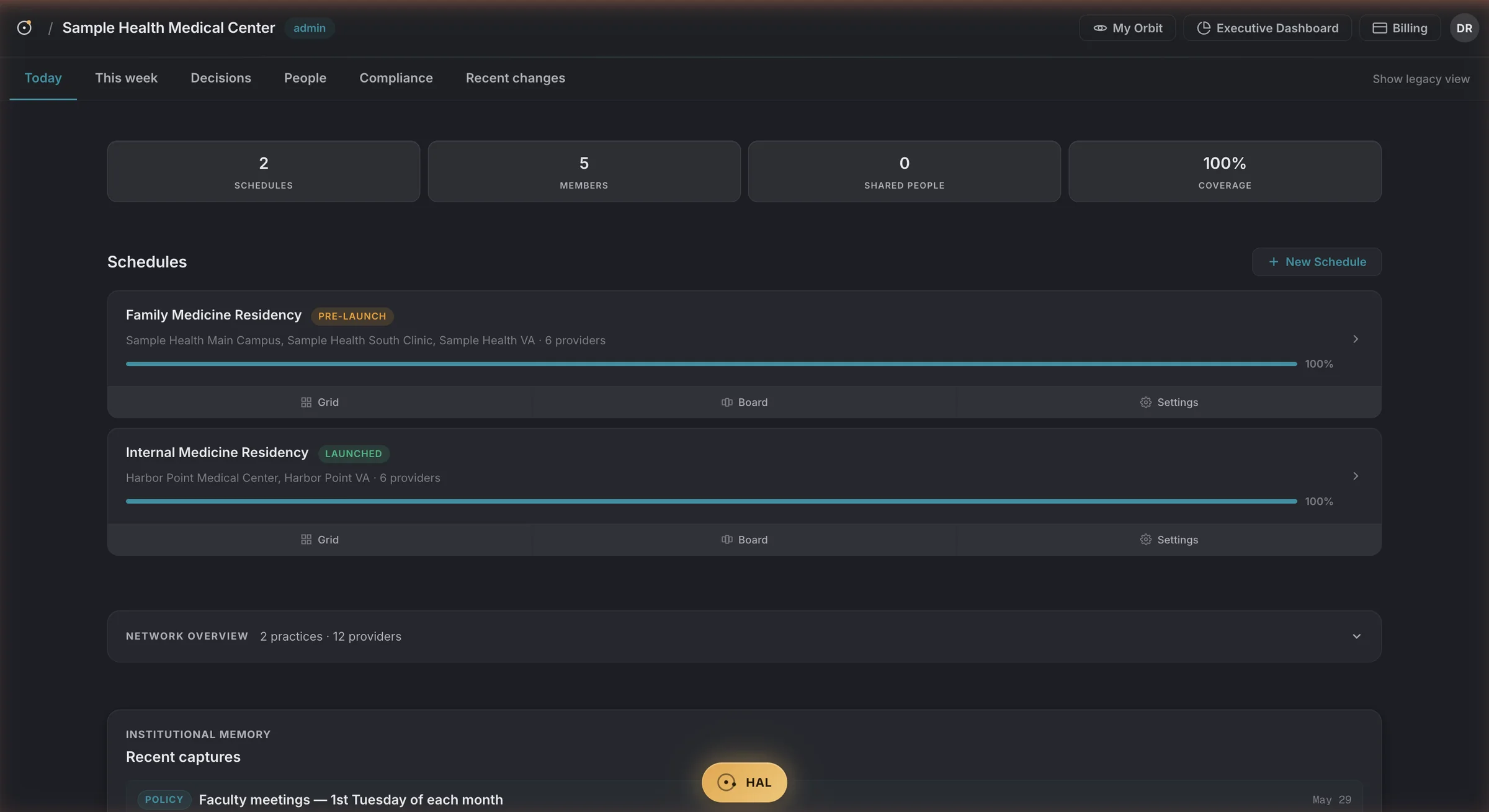
Orbit replaces that with one integrated platform where the schedule is the operational source of truth across every department, every site, every shift. Cross-department coordination becomes a structured workflow, not an anecdotal one. Resource utilization is a roll-up the practice manager can read in 60 seconds, not a spreadsheet they assemble at the end of the quarter.

Six capabilities, one operational source of truth

Everything below shares the same weekly schedule. The practice manager reads from one surface; the directors edit on the same one.

🔁

Cross-department resource sharing

Borrow people and rooms across departments without leaving the schedule. The borrowed resource shows up structurally on the borrower's grid; both sides see the agreement; completion clears future cells while preserving history. The workflow that distinguishes Orbit from single-business-unit tools.

See the workflow →
📍

Multi-site coordination

Shared sites, shared roster, cross-schedule conflict detection. A provider rotating between three locations has one identity and one schedule. The practice manager sees who's where this week without opening three spreadsheets. Site capability tags (procedures, equipment, services) drive smart staffing.

📊

Resource utilization roll-ups

Per-site, per-session, per-department utilization with revenue context. Which rooms are full, which sit idle, where capacity is bleeding away. Operations directors get the roll-up that turns a Monday standup into a 5-minute decision instead of a 30-minute presentation.

Utilization details →
🩺

MA & support staff coverage

Targeted coverage intelligence per session and per site, not blanket headcount. Orbit detects coverage gaps before they hit, surfaces who's available across departments, and flags when a session is one MA short of running clean — without forcing the manager to memorize the staffing model.

🔍

Full audit trail

Every loan, every schedule change, every approval, every override. Who did it, when, with what reason. Operations leaders get the accountability layer compliance and finance need without bolting a separate audit system to the schedule.

How audit works →

Real-time sync across locations

A change at one site is visible at every other site instantly. Coordinators editing in parallel don't clobber each other. Mobile and desktop stay in sync. The whole group runs on the same canonical week, every minute of the day.

Borrow people and rooms across departments without leaving the schedule

Most scheduling tools are single-business-unit. They assume one department, one roster, one schedule. Multi-department institutions live with parallel spreadsheets, no shared roster, and a Slack channel where chairs ask each other — can I borrow Dr. Chen on Tuesday? Can Internal Medicine use Procedure Room 4 next week?

Orbit treats cross-department resource arbitrage as a first-class workflow. The four-layer architecture makes the loan structural, not anecdotal.

  1. Discover idle capacity Saved views surface availability across the org. The same view a coordinator uses to find their own residents becomes the slate a sibling chair queries when they need help. Discovery is composable, not bespoke.
  2. Negotiate through structured requests The owning chair sees pending requests on a board, approves with one click and a borrower-site picker, denies with a reason, or completes the loan when it ends. Both sides see the agreement the whole time.
  3. Execute atomically on the schedule Staff loans add the borrowed person to the requesting department's grid. Room loans render a virtual row under the borrower's chosen site for the loan window, with a provenance badge. People get assigned inline like any other cell — the loan is real on the schedule, not just a tracking record.
  4. Audit every agreement Every loan carries provenance: who requested, who approved, when, with what reason. Completion clears future cells while preserving past assignments as historical record. Compliance and finance reads from the same source the work runs on.

And the scheduler doesn't have to go looking first. Ask HAL in plain English — who can lend me an MA Tuesday afternoon? — and it searches every sibling department, returns only the people actually free for that slot, and drafts the request right there. Each program decides which roles it lends — we'll lend our MAs and nurses, never our residents — in one sentence to HAL, and until a program opts a role in, nobody from it is ever surfaced to another department. The discovery hop and the request hop collapse into a single question.

No other scheduling tool we've seen treats this as a primitive. Float pools require formal labor models that academic departments don't have. Slack channels are unstructured and unaudited. Orbit makes the workflow structural — and that's the line we draw against single-business-unit tools.

Internal Medicine · West Loop · Tue PM
Borrowing
Room
Provider
Resident
MA
Room 1
Dr. Patel
R. Martinez
A. Liu
Room 2
Dr. Khan
B. Nguyen
🚪 Procedure Room 4 from Dermatology
Dr. Reyes
S. Cho
M. Garcia
🚪 Procedure Room 4 — Borrowing from Dermatology · West Loop Active

The roll-up that turns a Monday standup into a five-minute decision

Operations directors at multi-specialty groups spend disproportionate time assembling utilization roll-ups: how many rooms ran in each session, where capacity sat idle, which sites underperformed against staffing, what the per-session revenue context was. Most of that work is reconciling spreadsheets pulled from three different systems.

Orbit ships the roll-up live. Every published schedule feeds per-site, per-session, per-department utilization with revenue context the practice manager can read in a glance.

Supports per-session revenue overrides, MA-coverage thresholds, idle-capacity alerts, week-over-week trends, and per-provider productivity reads when admin-tagged data is present.

Week of May 4 · Multi-Specialty Group · Sample Roll-up
Sessions scheduled87
Sessions filled81
Average room utilization93%
MA coverage on target76 / 81
Cross-dept loans active3
Idle-capacity sessions flagged6

Every change carries provenance — without a separate audit system

Operations leaders, compliance officers, and finance partners want the same thing for different reasons: they need to know who did what, when, and why. Most scheduling tools either lose that information after the fact or push it into a separate audit application that's a quarter behind. Orbit captures it inline, on the same surface the work runs on.

01 · Schedule edits
Cell-by-cell change log
Every cell write captures who, when, and what value was replaced. Roll-up by week, person, or site. The override trail compliance asks for — without a separate query.
02 · Loan agreements
Provenance on every borrow
Every cross-department loan carries the requesting department, owning department, approver, reason, slot list, and execution result. Past loans stay as historical record; completion writes are atomic.
03 · PTO & coverage
Approval chain captured
PTO requests, approvals, denials, swaps, mayday cascades — each one gets an audit entry with the reason given and the decisions made. The retroactive question gets a non-retroactive answer.
04 · HAL writes
Every AI action visible
When HAL drafts a coverage suggestion or auto-generates a week, the action log captures the inputs, the proposed change, and whether a human confirmed. AI assistance with the audit trail compliance expects.

Where practice management software ends and Orbit starts

Practice management platforms (Athenahealth, Tebra, Kareo, eClinicalWorks) are EMR-and-billing systems that include a scheduling tab. Single-business-unit scheduling tools (Quinyx, Deputy, 7shifts, Connecteam) handle one team and one set of shifts. Neither category treats cross-department resource sharing as a workflow primitive — because neither category was built for the multi-specialty operational layer.

Orbit is built by a practicing department chair who runs multi-site operations every week. The capabilities on this page exist because an operational pain point made them necessary — not because a roadmap committee thought they'd be nice to have. This is the software multi-specialty groups have been assembling out of three other tools and a Slack channel.

Put your group on Orbit

Start free. No credit card. Cross-department arbitrage, multi-site coordination, utilization roll-ups, and the audit trail activate the moment you publish your first schedule.

Start Your Free Group
✓ Multi-specialty by design · Multi-site by default · Works across academic and private settings
Where Orbit Plays

Other ways to read the platform

Operations Layer

Medical Groups

Cross-department arbitrage, multi-site coordination, utilization roll-ups, and the audit trail. Built for practice managers, operations directors, and group administrators.

You are here
Residency Stack

Academic Medicine

The full residency stack — ACGME compliance, continuity, training exposure, institutional dashboard, GME finance, and chief resident handoff.

Visit page →
Flagship Vertical

Dermatology

Mohs-aware scheduling, medical / cosmetic / surgical day mix, and procedure balancing. The deepest vertical build — for residency or private practice.

Visit page →